Commentary: This was the first episode that I came up with. I wanted to do a good introduction into the topic of elevators. I had never done a podcast before, so there were a lot of details to figure out. I had to do a lot of writing, and learn about multiple different software platforms. Even after learning everything and putting together the episode, I still didn’t know how it would turn out. As an avid podcast listener myself, I wasn’t sure if the sound would come out the way I envisioned. I also wasn’t sure if I was talking too fast or too slow. This podcast had been on my mind for a couple of years, so I was excited and anxious to get it started.
Episode Transcript: Transcribed by TurboScribe.ai
“Welcome to Elevators Uncut and welcome to our very first episode.
I’m your host Joe Caperna. I’ve been wanting to publish this for a while so thank you for stopping by and I hope you enjoy the show. Since this is our first episode there’s a few things that I’d like to explain before we get started.
First, I won’t be using any real-life events when we discuss elevator content. This show is meant to be based on fictional events connected to real life elevator capabilities and limitations. Second, I won’t be using any private or proprietary information. All of the content will be based on open-source information and referenced in the show notes. Third, all content is my personal view and it’s not the view of any specific authority or entity. Now that we’re done with the formalities let’s get into the reason that we’re all here.
I’ve been working in the elevator industry for almost 10 years. I’ve also served in the military as an army engineer officer. I’m a certified Project Management Professional and I currently manage elevator modernization projects for a publicly traded elevator company.
During my time in the elevator industry I’ve noticed that many non-industry people I talk to don’t have a experience with the technical side of elevators. In fact, most people I talk to get the majority of their information from television or movies. Now, I’m a big fan of tv shows and movies and one of the things I noticed is that people get very interested when discussing elevator scenes and movies or shows. Particularly when we discuss whether the scene could or could not happen in real life. I’m normally pretty outspoken and stick to my opinion that inside the elevator is the safest place you can be. There is a lot more danger trying to evacuate an elevator than there is waiting for the professionals to arrive. And those conversations are the reason that we’re here today. My intent is that during every episode we discuss at least one fictional television or movie scene that features an elevator and we also discuss why it likely could or could not happen. Since this is our first episode I’d like to start with a reading. This particular reading is from the book Elevator Pitch by Linwood Barclay. I put a link to this book on Amazon in the show notes if you’d like to check it out. I’m going to read an excerpt from the book jacket as well as an excerpt from the story itself. So without further ado here we go:
‘It all begins on a Monday when four people board an elevator in a Manhattan office tower. Each presses a button for their floor but the elevator proceeds non-stop to the top. Once there it pauses for a few seconds but the doors don’t open. Instead the elevator begins to descend floor by floor then it plummets right to the bottom of the shaft. It appears to be a random accident the kind that seems to happen all too often in a city like New York. Crane collapse, subway fire, elevator malfunction. But on Tuesday it happens again in a different Manhattan skyscraper and then Wednesday brings yet another tragic high-rise catastrophe. In only three days one of the most vertical cities in the world and the nation’s capital of media finance and entertainment is plunged into chaos.
Clearly this is anything but random. This is a cold calculated bid to terrorize the city and it’s working. Fearing for their lives thousands of people who work in high rises across the city refuse to leave their homes. Commerce is slowed to a to a trickle. Emergency calls to top floors of apartments and towers go unanswered. The mayor already embroiled in a growing scandal is desperate for answers.
Who is behind this? Why are they doing it? Are these deadly acts of sabotage somehow connected to a fingerless body found on the high line? Two seasoned New York detectives and a straight shooting journalist race against time to uncover the truth before the city’s newest and tallest residential tower has its ribbon cutting on Friday night. This is a very interesting topic for me. As someone from the elevator industry I take interest in how the general public and passengers respond to incidents involving elevators.’
I’ve seen various levels of elevator shutdowns in different cities that I’ve worked. Even without catastrophic levels of events my perception is that the public is generally scared and anxious about being involved in an elevator incident. It’s interesting to think about what would happen in the public at large if incidents like these were more frequent or somehow deliberate.
So let’s get in to the topic a little deeper by reading an excerpt from chapter one. This starts on page six:
‘The elevator door is closed. Sherry press 33, sneaker girl 34, and business guy 37. When Stewart did not reach over and press one of the many buttons the man who was standing closest to the panel glanced his way slightly offering to press a button for him. I’m good, he said.
The elevator silently began its ascent. Sherry and the other woman looked up to catch the latest news. The elevator was fitted with a small video screen that ran kind of like a Chiron, a line of headlines moving from right to left.
New York forecast high 64, low 51, mostly sunny. Stewart moved forward half a step so he was almost rubbing shoulders with Sherry. How are you doing today Miss D’Agostino? She turned her head from reading the screen and said, fine, thank you. And then she knew who it was. Her eyes flickered with fear. Her body leaned away from him, but her feet were rooted to the same spot on the elevator floor.
Stewart held out the FedEx package. I wanted to give you this. That’s all. I just wanted you to have it. I told you to stay away from me, she said, not accepting it. The man and woman turned their heads. It’s cool, Stewart said, smiling at them. Everything’s fine. He kept holding out the package to Sherry.
Take it, you’ll love it. I’m sorry, you have to. Okay, okay, wait. Let me just tell you about it then. Once you hear about it, I guarantee you’ll like to read it. The elevator made a soft whirring noise and sped past the first 20 floors.
Sherry glanced at the numbers flashing on the display above the door, then read up to the news line. Latest unemployment figures show rate fell 0.2% last month. She sighed, resistance fading.
You’ve got 15 seconds, she said. If you follow me off, I’ll call security. Stewart beamed.
Okay, right. So you’ve got this guy. He’s like 30 and he works 10 seconds, she said.
Sum it up in one sentence. Stewart suddenly looked panicked. He blinked a couple of times, his mind racing to encapsulate the brilliant script into a phrase to distill it into its essence.
Um, he said, five seconds, Sherry said. The elevator almost to the 33rd floor. Guy works at a factory that makes clocks, but one of them is actually a time machine, he blurted.
He let out a long breath, then took one in. That’s it, she said. No, he said. There’s more, but to try to explain it in what the hell, Sherry said, but not to him. The elevator had not stopped at her floor. It shot right past 33 and then glided right on by the 34th.
Crap, said sneaker girl. That’s me. The two women reached out to the panel at the same time to press the button for their floors again.
Their fingers engaged a bit of fencing. Sorry, said Sherry, who’d managed to hit the button for her floor first. She edged out of the way.
U.S. militant group flyovers, prime suspect in Seattle coffee shop bombing that killed two. As the elevator continued its ascent, business guy grimaced and said, guess I’ll join the club. He put his index finger to the 37 button.
Someone at the top must have pushed for it, sneaker girl said. It’s going all the way up first. She turned out to be right. The elevator did not stop until it reached the 40th floor. But the doors did not open. God, I effing hate elevators, she said.
Stewart did not share her distress. He grinned. The elevator malfunctioned and brought him a few extra seconds to make his pitch to Sherry.
I know time travel has been done a lot, but this scenario is different. My hero, he doesn’t go all the way into the past. He can only go five minutes one way or the other. So business guy said, I’ll walk back down. He pressed the button to open the doors, but there was no response. Jesus, he murdered.
Sherry said we should call someone. She pointed to the button marked with the symbol for a phone. It’s only been a few seconds, Stewart said.
It’ll probably sort itself out after a minute or two. And with a slight jolt, the elevator started moving again. Finally, sneaker girl said.
Storm UK approaching hurricane status. The interesting angle is, Stewart said persistently, if he can only go five minutes into the past or five minutes into the future, how does he use that? Is it kind of superpower? What kind of advantages could that give someone? Sherry glanced at him dismissively. I’d have gotten on this elevator five minutes before you showed up.
Stewart bristled at that. You don’t have to insult me. The descending elevator gone past another floor.
The man jabbed at 37 again, more angrily this time. The elevator sailed past floors as two women as well, but stopped at 29. Oh, come on, business guy said.
This is ridiculous. He pressed the phone button. He waited for a moment, expecting a response.
Hello, he said. Anyone there? Hello. This is freaking me out, sneaker girl said, taking a cell phone from her purse.
She tapped the screen, put the phone to her ear. Yeah. Hey, Steve, it’s Paula. I’m going to be late. I’m stuck in the effing Ella. And there was a loud noise from above, as though the world’s largest rubber band had snapped.
The elevator trembled for a second. Everyone looked up, stunned. Even Stewart, who had stopped trying to sell his idea to Sherry Agostino.
Crap, said sneaker girl. What the hell was that, Sherry asked. Almost instinctively, everyone started backing up toward the walls of the elevator, leaving the center open.
They gripped the waist high brass handrails. It’s probably nothing, Stewart said. A glitch, that’s all.
Hello, business guy said again. Is anybody there? For Christ’s sake, this elevator’s gone nuts. Sherry spotted the alarm button and pressed it. There was only silence. Shouldn’t we have been hearing that? She asked. The man said, maybe it rings someplace else, you know, so someone will come down at security desk, probably.
For several seconds, no one said anything. It was dead silent in the elevator. Everyone took a few calming breaths. Your life expectancy is now nearly 80. Stewart spoke first. Someone someone will be along.
He nodded with false confidence and gave Sherry a nervous smile. Maybe this is what I should be writing up. The elevator began to plunge.
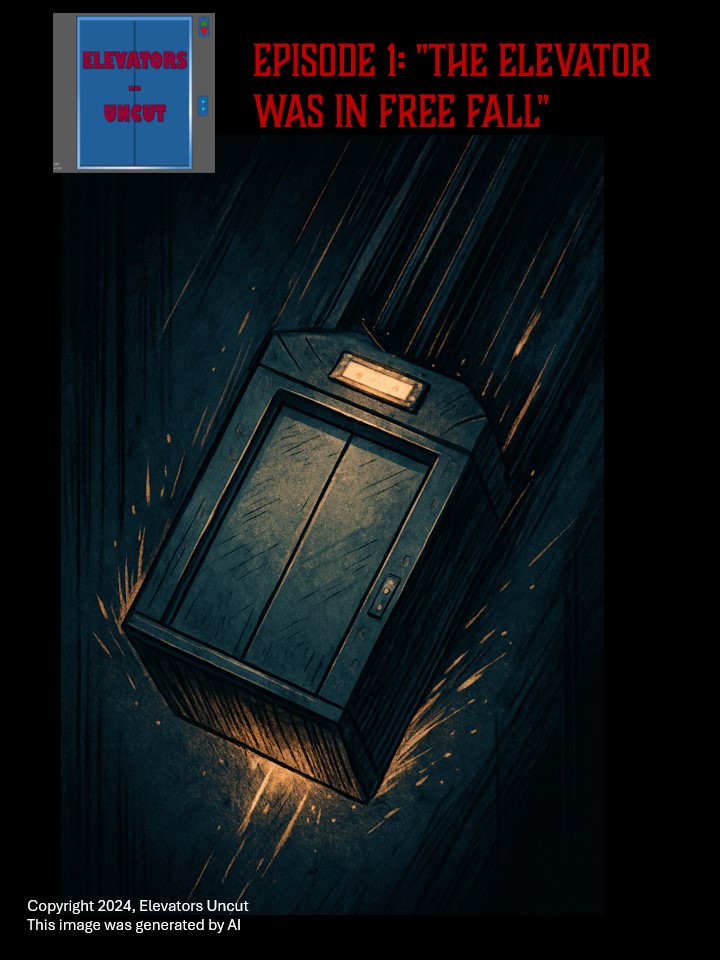
Within seconds is going much faster than it was designed to go. Stewart and Sherry and the two others felt their feet lifting off the floor. The elevator was in free fall until it hit bottom.’
Now, if this is a subject that interests you, I strongly recommend that you start with Zach McCain’s book, Elevators 101. It’s the book that’s recommended to us when we start in the industry, and I think it’s a great spot to get some foundational knowledge. We’re definitely going to reference that book when we discuss these fictional scenes, so it would help you kind of understand the terminology and what things we’re talking about.
It’s about 130 pages. It covers all major parts of elevators and some escalators. This is also a good place to become familiar with a lot of the elevator terminology that I’m going to use in this podcast and in future episodes.
I’ll put a link to the book in the show notes for you. So let’s get started with the analysis of this scene from Elevator Pitch, and we’re going to do this like we do for every episode of this podcast and every scene that we analyzed. The objective is to describe generally what happened in the scene from an elevator perspective, then discuss why or why not it could potentially have happened like that.
To do this we’ll have to make some general assumptions about the equipment and the general speed of the equipment and heights of the buildings and some other general parameters. So in this scene there are several passengers in the elevator. They’re all going to different floors, the highest floor being the 37th floor.
From this information we can assume it’s a high-rise building with a rise of at least 450 feet. That’s assuming an average floor height of about 12 feet for the 37 floors. For this size building we will also assume an elevator speed of about 800 feet per minute. Could be faster, but 800 is a safe assumption. This could probably be up to a thousand feet per minute, but not more than that. Keep in mind that 800 feet per minute seems fast, but it’s barely more than nine miles an hour. Of course nine miles per hour in an elevator shaft looks and feels a lot faster than it is out in the open. So these four characters are traveling up the elevator hoistway trying to stop at four separate floors. The book says that the elevator bypasses all the floors despite the car call that was entered by each passenger.
This is our first clue. From inside the elevator you would see the car call remaining lit on the car operating panel until it reached the floor. Eliminating any elevator monitoring systems that might be in place of this building, the only place to eliminate a car call is from the elevator controller in the elevator machine room. There’s a good diagram of an elevator system in chapter four of elevators 101, but there’s also plenty of online photos or graphics if you do a search. Getting back to the story, the elevator is bypassing floors in the up direction and isn’t stopping at any of these floors. We can assume it means that there are no hall calls being placed in the system with people waiting to go up on the same elevator, or any hall calls that have canceled. If there was, for example, someone waiting to go up on floor 21, we would assume that the elevator would stop at the 21st floor and pick that person up to continue up to a higher floor. Again, to cancel any hall calls that there might be, it’s likely done from the elevator controller somehow. After bypassing the floors, the elevator reaches the top landing. We’ll assume that it’s the top landing because if the elevator were to go into the overhead of the hoistway, it would hit the top final limit switch and shut itself down. It’s also possible that the counterweight would hit the buffer in the elevator pit and also shut the elevator down. Once these mechanical switches are activated, there is no way to electronically reset the elevator, so we’ll assume that the elevator didn’t trigger any of these limit switches and is just sitting at the top landing of the hoistway.
With the elevator at the top landing, we’ll assume that the elevator driving machine is gearless due to the rise of the building. There’s a good image of a gearless machine in chapter 5 of elevators 101. Then the elevator began to plunge and go much faster than it was designed to go, per the author.
Now there’s a difference between design and rating. Generally the elevator is designed to go for any number of different speeds above and beyond the normal operating speed, but there’s specific constraints as to why the rated speed is what it is, particularly the height of the elevator pit in the overhead. In this case we’ll say that the elevator is moving in the down direction faster than its rated speed of 800 feet per minute, which is our assumption from earlier. We’ll also say that the elevator is truly free-falling and is subject to the normal force of gravity. I found a free calculator online called Omni Calculator that did the calculation for me. After half a second the elevator would be falling at 10 miles per hour, which would also start the overspeed response on the elevator governor.
This is where we take a break from the story for a second because elevator governors are going to probably be the most popular topic for every episode we do. The elevator governor or speed governor is what makes it so that the elevator can’t exceed a certain speed in the down direction. That certain speed is the rating for that elevator.
Chapter seven in elevators 101 has several different photos and descriptions of governors and how they function. Basically, there are two switches on the governor that we need to keep in mind. The electronic switch is the first switch to engage during an overspeed situation. The electronic switch disables the power to the elevator machine, which prevents the machine from running. The second switch is a mechanical switch, which activates a jaw or similar device that clamps down on the governor cable. This mechanical switch would only be activated if the electronic switch did not stop the elevator from exceeding speed in the down direction. When the mechanical switch is activated, the jaws clamp down on the cable. The cable pulls on a safety rod that is connected to the safeties on the elevator itself. Now the safety rod deploys the elevator safeties which set into the guide rails alongside of the elevator cab. Traditional wedge safeties make it impossible for the elevator to fall after they’re deployed. They kind of wedge themselves between the safety frame and the guide rails inside the hoistway. The only way to disengage these wedge safeties is to move the elevator into the up direction and reset them.
There’s actually several examples of safeties with graphics in chapter nine of elevators 101. Now I’m sure you’re saying, but what if the governor cable was cut or the governor was broken? Well, the beauty of an elevator governor is that the cable has to have tension on it at all times. As soon as you remove tension, the safety is deployed. Sometimes we even have issues with safeties partially deploying and scraping the guide rail because there’s the governor cable is stretched or there isn’t enough tension on it. Now the safeties are at the bottom of the elevator and attached to the elevator frame itself. So in order to do anything to the safeties, you’d actually have to be underneath the elevator within reach of the bottom of the frame.
There might be a couple of you saying, what about the Tower of Terror in Disney? Well, ignoring the fact that’s a ride and not connected to safety requirements of a normal elevator, the design of that traction is extremely technical and has essentially two separate elevators running the car pulling in opposite directions. Getting back to our story, the elevator would fall approximately four and a half feet before the governor overspeed switch tripped. That’s the electronic switch.
The mechanical switch would trip shortly after and deploy the safeties. Due to the weight of the elevator, it would slide another 18 inches or so once the safety is deployed. So even tripling the distance would make the total travel about 12 feet before the safety stopped the elevator in the down direction.
So let’s explore another scenario for the skeptics out there. Let’s say that the perpetrator in this story was able to run the elevator in the down direction and keep the speed under the rated speed. So in this case, the elevator would run down about nine miles per hour in the down direction from the 37th floor.
Using another calculator that I found online from calculator soup.com, it would take about 34 seconds to run down from the 37th floor without stopping. Again, this would assume that the perpetrator was able to eliminate all the hall calls in the down direction from the elevator lobbies so that no one could stop the elevator and get on. So two things will happen when the elevator passes the bottom landing at nine miles per hour.
The first thing is that the elevator will trip the terminal slowdown switch inside the elevator shaft. This ensures that the elevator doesn’t go beyond the farthest point in the shaft. At this point, the elevator can’t travel any farther.
Also at this point, the elevator counterweight is at the top of the hoistway and will also have some space restrictions where it can’t go any farther. As the elevator passes the bottom limit switches, power will shut down and slow the elevator before it hits the elevator buffer that’s in the pit. Since we agreed that the elevator can’t exceed the rated speed, the limit switches would shut the elevator down using the elevator power and prevent it from continuing down the hoistway.
There would be a short amount of time where the elevator would glide to a stop before the machine brake sets, but at the rated speed it would only be about a half second or so. And if the limit switches didn’t cut power to the elevator, this elevator would also have an oil filled buffer at the bottom of the elevator pit that’s designed to absorb any impact from the ascending elevator. So under normal speed, there would be no issue.
For the other skeptics out there saying, how do you know all of these devices would work? That’s a reasonable question. However, at least in the United States, in the elevator industry, the test requirements are very strict. So depending on the state that you’re in, there may be a different code year that has been adopted statewide.
In New York, they’re usually up to a very, very current date. But for the most part, even the oldest codes are fairly strict. Chapter three from elevators 101 has a good summary of a 17.1 safety code for elevators.
But in short, every safety system on a traction elevator like this one in the book would be tested at a minimum of five years with full capacity of test weights. All the safety switches would be tested as well as the car safeties themselves, the buffer switches, and all the safety circuits on the elevator. Some jurisdictions even require an annual safety test without the full weight in addition to the five year requirement.
And that, my friends, is all we have for this first episode of Elevators Uncut. Rest assured, though, I’m working diligently on more episodes, and I have some great ideas on different scenes and movies and shows that we can discuss. So until then, try to relax.
Thank you so much for listening. This is something I’ve wanted to do for a long time, and it means a lot to me to have it become a reality. If you enjoyed the episode and you’re asking yourself, how do I hear more episodes? Well, the most helpful thing you can do to make that happen is leave a rating and review for this podcast.”
References used during Episode 1:
Barclay, L. (2019). Elevator pitch: A novel. William Morrow.
McCain, Z. (2005). Elevators 101. Elevator World Educational Fund.
American Society of Mechanical Engineers. (2019). ASME A17.1/CSA B44: Safety code for elevators and escalators. ASME.
Omni Calculator. (n.d.). Physics calculators. Omni Calculator. Retrieved April 4, 2024, from https://www.omnicalculator.com/physics
Furey, E. (n.d.). Calculator Soup – Online calculators. Calculator Soup. Retrieved April 4, 2024, from https://www.calculatorsoup.com/
Just a few of the many links to this episode online:
Elevators Uncut – Podcast – Apple Podcasts
Elevators Uncut | Podcast on Spotify
Elevators Uncut – Podcast Addict
 Elevators Uncut
Leave a comment